What should you say when an influencer walks in asking for free food?
It is Friday at seven. A guest at the host stand holds up a phone with a big follower count. They offer a post in exchange for dinner for four. Your host has about ten seconds to answer.
Thank them and say no to free food on the spot. Hand them a card with one email or form for creator requests. Say the manager reviews requests each week. Offer to seat them as paying guests tonight. Train every host on the same words. Never argue about follower counts.
客腾引团队阅读约 6 分钟
客腾引(CreatoRain)是面向连锁和加盟餐饮品牌的全托管美国网红营销服务,由客腾引自己的团队寻找并邀约美食博主、支付博主报酬,并一路跟进到每条视频发布。

Why does your host need a set answer?
Walk-in requests are now routine. In a New York Post report, small restaurants and coffee shops said they get these asks every day. Some get one or two, and some get many more. A host who has to improvise will sometimes say yes just to end an awkward moment.
A yes is rarely free. One owner in Queens agreed to comp a creator’s meal for a post. The creator then ordered five entrées, two appetizers and four drinks. It came to about $200, and no post followed. A café owner in the same report said creators ask her for $500 to $3,000 just to be featured.
- A comped meal that never got a post
- $200
- What creators asked one café to pay for a feature
- $500 to $3,000
The ask is also a guest moment, watched by the tables around it. Toast asked 1,466 U.S. adults how they discover new restaurants. Word of mouth ranked first, at 38%. A polite, practiced no keeps that story friendly, whatever the answer.
What should the host say, word for word?
Keep the script short enough to say in one breath. It thanks the guest and says no to a free meal tonight. Then it gives one place to apply. It never asks how many followers they have. Arguing about reach is how a calm no turns into a scene.
Thank them
“Thanks for thinking of us.”
They ask for a free meal
State the house rule
“We don’t comp meals at the door, for anyone.”
They offer a post
Give the one channel
“Here’s our card. Creator requests go to this email, and the manager reads them each week.”
They are still at the stand
Offer a table
“If you’d like to eat with us tonight, I can seat you now.”
They argue or threaten
Hand off if it heats up
The host calls the manager and steps back
The words “for anyone” do the heavy lifting. They make the no about a house rule, not about the person. Hosts should not judge whether a guest seems influential. Their only job is to point to the channel and offer a seat.
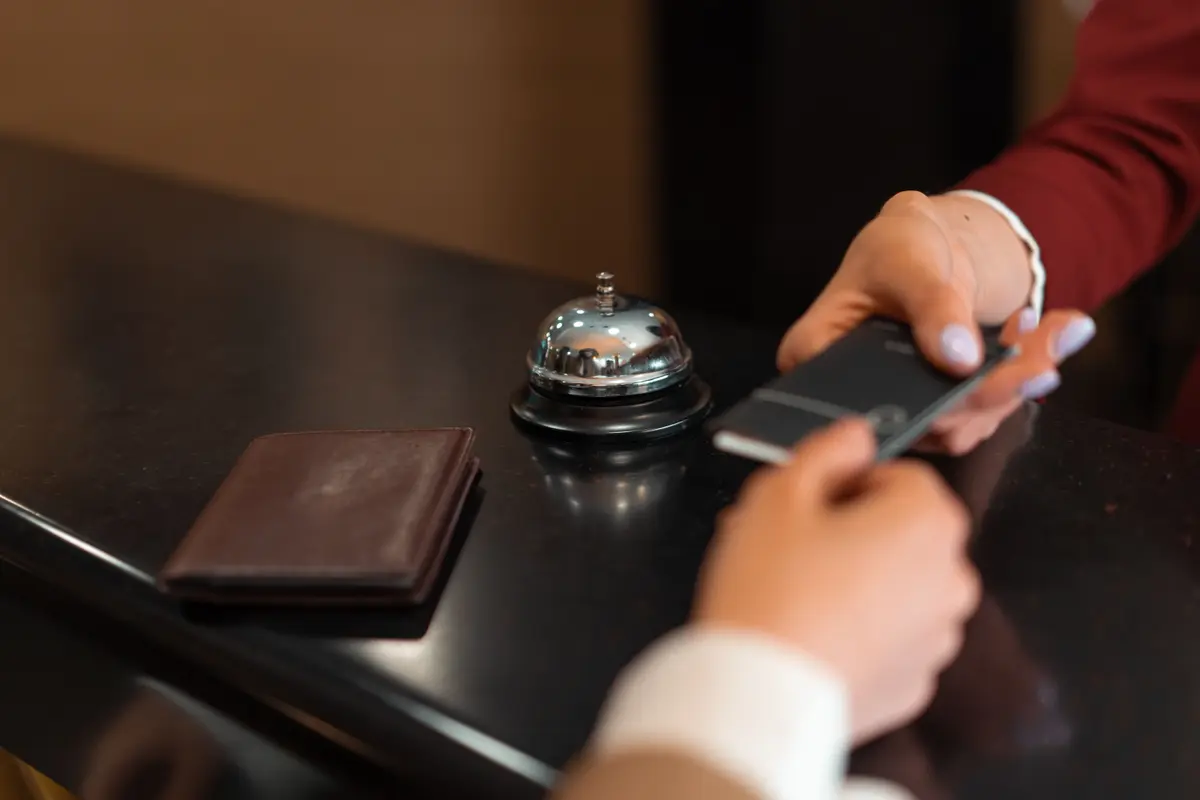
Where should creator requests go instead?
Pick one channel and print it on a small card. A shared email address works. So does a short web form. Ask for a name, a handle, the city they post from and a link to a recent food post.
Then give one person the inbox. A manager or marketing lead reads it once a week, at a set time. That person looks at each creator’s recent posts. Do they post about restaurants in your area? Do the comments read like real local followers? One owner on Reddit’s r/restaurant put the goal plainly. That owner wants customers who live within a 20 mile radius, not a national audience.
What goes on the creator card
- One email address or form link, the same at every store
- A line saying requests are read once a week
- That you look for food creators who post from your area
- No promise of a free meal
- The store’s name, so the request reaches the right location
What goes in a one-page walk-in policy?
Write the rule down so every shift gives the same answer. Keep it to one page. Pin it by the host stand and in the manager’s office, and read it with each new host.
| Rule | What it means at the door |
|---|---|
| No comps at the door | Nobody gets a free meal for an offered post, whatever their follower count |
| One channel | Every creator request goes to the email or form on the card |
| One reviewer | A named manager reads requests once a week and replies to each one |
| Hosted meals are booked ahead | The date, guest count and set menu are agreed in writing first |
| Threats go up | The host passes any threat to the manager and says nothing more |
If you run a franchise, check with your franchisor before you print the card. Some brands already set rules for comps, gift cards and local promotions. Ask whether yours has one, and fit your card to it. For how brand rules reach creator posts, see whether a franchisee can hire influencers without approval.
How should staff answer each version of the ask?
The request comes in a few shapes. The answer stays the same, and only the first line changes.
| They say | The host says |
|---|---|
| “I’ll post about you if dinner is free.” | “We don’t comp meals at the door, for anyone. Here’s where creators apply.” |
| “I have a huge following.” | “That’s great. The manager reads every request sent to this email.” |
| “Can my friends eat free too?” | “Hosted visits are booked ahead, with a set guest count.” |
| “Another place gave me a free meal.” | “Every restaurant has its own rule. Ours is the same for everyone.” |
| “I’ll leave a bad review if you say no.” | The host stays polite and gets the manager. |
Notice what the replies leave out. None of them comments on the guest’s reach, content or looks. Each one ends on the card or on a table for tonight.
What if they threaten a bad review?
Stay calm and write down what was said, with the time. Do not offer food to make it go away. Google’s review policy bans offering free goods or services for a review, or for removing a negative one. Yelp’s guidance tells businesses not to offer freebies in exchange for reviews either.

在此播放会加载 YouTube 的播放器,该播放器可能设置自己的 Cookie。
Sometimes the threat turns into a wave of bad reviews. Google has a help page on review extortion for this case. It describes a sudden rise in 1-star and 2-star reviews, followed by a demand for money, goods or services. Google’s advice is not to engage and not to pay. Report it through the form on that page instead. If a bad review does go up, see how to respond to a bad restaurant review. To build a steady base of honest ones, see how to get more Google reviews.
How do you get every host to use the same words?
Train it like any other service step. Read the script aloud at a pre-shift meeting. Have two hosts role-play the pushy version once. New hosts learn it in their first week, with the card in hand.
Check the habit every few weeks. Ask managers how many walk-in asks came up, and whether anyone comped one. A comp at the door usually means a host felt cornered, so practice that version again.
When is a free meal worth offering?
A hosted meal can still pay off. It just starts with your invitation, not their walk-in. The host can say so in one line: creators who ask ahead are welcome to apply.
What to agree before a hosted visit
- The date, the time and the store
- How many guests come, and what the set menu covers
- What the creator posts, and by when
- That the post tells viewers the meal was a gift
- Who tips the server, and on what amount
Each of those terms has its own guide. Start with how to invite food influencers, then read whether creators should tip on a free meal. Read how creators disclose a free meal, and whether to pay creators instead. If a hosted creator never posts, here is what to do next.
The address on your card can also point to an outside service. CreatoRain is one such channel. Its in-house team invites creators from its food-creator network to visit each store. It pays them and follows up until each video is posted. The price is $300 a video, creator pay included. The script above works with or without it.
来源与方法
文中每个数字的来源
- “$200” — NYC restaurants taking a stand against food ‘influencers’ demanding free meals: ‘I say no’ (Jeanette Settembre, New York Post via Yahoo News, December 3, 2025). 查阅于 October 8, 2026。
- “$500 to $3,000” — NYC restaurants taking a stand against food ‘influencers’ demanding free meals: ‘I say no’ (Jeanette Settembre, New York Post via Yahoo News, December 3, 2025). 查阅于 October 8, 2026。
- “1,466” — How Guests Discover New Restaurants in 2026 (Caroline Price, Toast, July 30, 2026). 查阅于 October 8, 2026。
- “38%” — How Guests Discover New Restaurants in 2026 (Caroline Price, Toast, July 30, 2026). 查阅于 October 8, 2026。
- “20 mile” — Working with influencers (r/restaurant, Reddit, February 13, 2024). 查阅于 October 8, 2026。
- “1-star and 2-star” — Report negative review extortion scams on your Business Profile (Google Business Profile Help). 查阅于 October 8, 2026。
- “$300” — 见我们价格方案页面上公布的条款。
文中引用的页面
- NYC restaurants taking a stand against food ‘influencers’ demanding free meals: ‘I say no’ (Jeanette Settembre, New York Post via Yahoo News, December 3, 2025) 查阅于 October 8, 2026。
- How Guests Discover New Restaurants in 2026 (Caroline Price, Toast, July 30, 2026) 查阅于 October 8, 2026。
- Working with influencers (r/restaurant, Reddit, February 13, 2024) 查阅于 October 8, 2026。
- Prohibited and restricted content (Google Maps user-generated content policy) 查阅于 October 8, 2026。
- Don’t Ask for Reviews (Yelp Support) 查阅于 October 8, 2026。
- Report negative review extortion scams on your Business Profile (Google Business Profile Help) 查阅于 October 8, 2026。
在美国不止一家门店? 看看客腾引如何服务连锁餐饮品牌。 看看真实的出海营销活动案例。